
Master Gardeners grow, donate and preserve local foods
UNIVERSITY OF MINNESOTA EXTENSION - www.extension.umn.edu

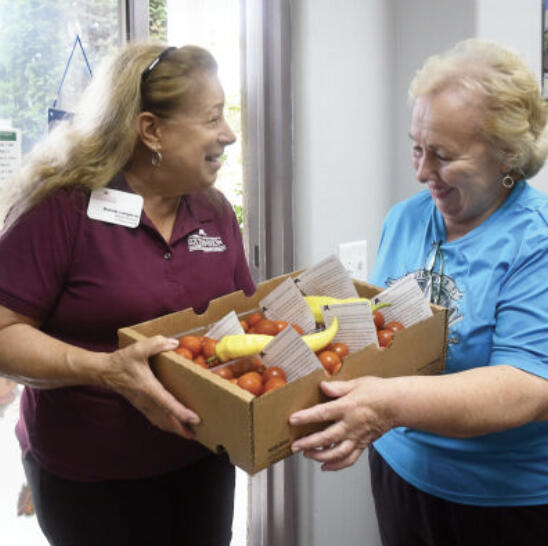
Brenda Langerud, left, delivers a box of freshly harvested vegetables with information about how to prepare them, to W-E Share Food Shelf coordinator Pat Nusebaum
Taking action on food security, Master Gardener volunteers like Brenda Langerud donated 63,372 pounds of produce to food shelves in 2025 — and 2026 numbers are coming in strong.
Brenda Langerud, a Master Gardener volunteer in neighboring Blue Earth and Le Sueur counties, donates 300 to 400 pounds of produce each year from her own garden and the community garden she started in Waterville. (Master Gardeners work with 150 community gardens statewide.)

Waterville Community Gardens even has apple trees.
“Brenda brings such good, wholesome vegetables and even some fruit,” says Pat Nusebaum, coordinator for the W-E Share Food Shelf, serving Waterville and Elysian. “It all goes out the door right away; our clients are really grateful for this blessing.”
“We have many miles to drive to reach grocery stores in parts of Minnesota, and people who have limited means and transportation need help getting fresh produce,” says Langerud. “Being trained by University of Minnesota Extension lets me do my best volunteer work on issues I care about. I am all for helping everyone access something healthy to eat.”
Forever the educator
When Langerud and her husband retired, they moved to Minnesota from North Dakota, where she was an Extension educator teaching topics like CPR for caregivers and household financial management.
One day, Langerud and her husband, Phil, were driving by a building in Waterville — a nonprofit called The Village. She saw some raised garden beds full of weeds.
“We stopped and I asked what they were going to do with those raised beds,” she says. “The director, a wonderful man, said, ‘Nothing. Is there anything you want to do with them?’ Phil went, ‘Oh, no.’”
That’s when Langerud flew into action, cleaning out the weeds and building more raised beds. She applied for, and received, grants to help with soil and supplies.
Community is everything
Next, Langerud built a community of gardeners. “Phil and I hung posters at the laundromat, the library, all the public places,” she says. “And, POOF! Our community garden was filled with people.”

When the Waterville City Council decided to buy the building, Langerud wasn’t sure what would happen with the garden beds. “They said, ‘Absolutely nothing. You just keep doing your thing.'”
Volunteering in two counties introduces Langerud to a lot of people. Some that she appreciates most are local business leaders. 2026 was the third year that Pioneer Bank of Mankato provided rent-free space to host the Blue Earth County Master Gardener “Spring Alive” education day.
Karla Reagles, Extension Master Gardener coordinator for Blue Earth and Le Sueur counties, says Spring Alive is a big effort and the volunteers help make sure it’s open to everyone.
“Brenda is so knowledgeable about horticulture,” says Reagles. “Along with Joyce Wilcox and numerous other Master Gardeners, she works to make sure Spring Alive brings success to everyone who wants to learn, whether they have all day or one hour, and whether they come by car or by bus.”
Investing in good health
With her economics education and work experience, Langerud feels that — although it takes time — buying $10 worth of seeds can pay off in many home-cooked meals.
Preserving the harvest prevents food waste, keeps nutritious foods on hand, and even makes affordable yet meaningful gifts. Langerud is a certified food preservation consultant, one of a growing number of Master Gardeners trained by Extension in the science of food safety.
Master Gardener volunteers share food safety information through social media and newsletters. Some have taught hands-on food preservation classes, and Langerud is hoping to be able to offer one to her community soon.
“It’s another step in food security that can take some investing, but it’s not all canning,” says Langerud. “You can freeze your green beans within an hour; you can dehydrate fruits and herbs. The idea of self-initiative — growing your own food, providing for your family — is very important.”
