
Vegetable Update - August 27, 2026
UNIVERSITY OF MINNESOTA EXTENSION - www.extension.umn.edu
Fall is in the air, and our classic fall vegetable problems are coming along with the cooler nights. While portions of the state entered extreme drought this week, we still have enough humidity and cool morning for dew – which drives the development and movement of many pathogens. We are out of the window where we have effective management available for disease problems, as many diseases are quite advanced, and disease management (even with pesticides) is preventative. Make notes of what problems are where on the farm, and make notes that will help you remember to trial helpful varieties and different cultural practices next year.
Hedging your bets about fall frost dates
We’re reaching the point where in a “normal” year, we would be about one month (northern MN) to one and a half months (southern MN) away from the first frost. You can look at fall frost date probabilities for your area here. Many growers start topping tomatoes around this time, encouraging plants to put their energy into existing fruit and flowers rather than making new ones. This is also the time to plant winter-killed cover crops if you want to get a good stand before winter. Our growing season has been getting longer due to climate change, with later first frost dates, but they’re still unpredictable. Just because they’re getting later on average doesn’t necessarily mean we won’t have an early frost this year. The NOAA 3-month weather outlook is showing a high likelihood of warmer than average fall temperatures. What does this mean for you? Unfortunately, it’s hard to say since we can’t predict annual variation. It might be worth holding off on topping your tomatoes for a week or two, but if your goal is a great cover crop stand, planting now is likely still worth it.
Japanese beetles
We are at the tail end of the period where adult Japanese beetles are flying. Some other states in the region, as well as some farms in Minnesota, have reported very high numbers of Japanese beetles, though overall it seems to be a pretty average population year for them.
They have an extremely wide host range of over 300 plants, and are typically more of a problem for fruit growers and gardeners than they are for vegetable farmers. Farmers who grow cut flowers like zinnias and marigolds are probably more used to Japanese beetles as a major farm pest, but here and there we see them feeding on basil and plants in the mallow family (including a couple of important African leafy green crops like molokhia/jute mallow, and hibiscus).
In small plantings, physical removal can be quite effective, especially if you find the beetles when there is only one or two on the plant. Once beetles start feeding, both the beetle and the plants emit chemical cues that attract more beetles. Pyganic and products with azadirachtin can help, row covers are also an option.
Crop updates
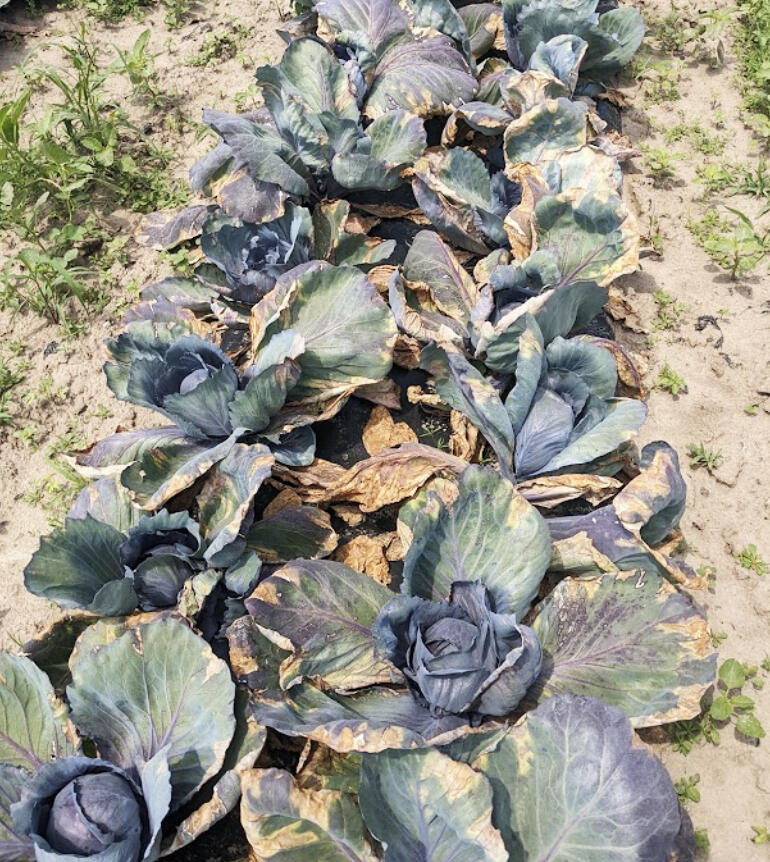
Cole crops: With dewy mornings, black rot is flaring up on some farms. This disease can be seed borne, then hangs around on the farm in decaying crop residue. It moves with water, and enters plants through wounds (from hail, harvest, weeding, etc.) or through natural openings on the edges of leaves. Infected plants will develop yellow V shaped lesions on the leaf edges.
 |
| A row of cabbages infected with black rot. Photo: Dan Egel, Purdue Extension. |
Bacterial diseases are tricky to manage. Some things to think of as we wrap up this year, and go into next year…
- Buy seed from reputable sources or heat treat your seeds.
- Check transplants for signs of black rot, and remove suspect plants
- Practice a 2-3 year rotation
- Manage weeds, especially brassica weeds like yellow rocket and shepherd’s purse
- Promptly remove/destroy and incorporate/mow brassicas after harvest
- Use largest plant spacing for fall crops
- Avoid working in fields when plants are wet
There are some pesticides available, but the efficacy of both conventional and organic products can be mixed, and all work preventatively (so won’t do much if your field looks like the above photos or worse). See the Midwest Vegetable Production Guide for more information.
Cucurbits: Squash mosaic virus showing up in squash and zucchini - we usually see symptoms get worse in the fall. There are quite a few viruses that show up, most are vectored by aphid, squash mosaic virus is the oddball that is vectored by cucumber beetle. Zucchini and squash with mosaic virus symptoms are still edible, they just might have reduced shelf life. Some growers find that mosaic viruses make fun/spooky/bumpy pumpkins that customers actually enjoy.
 |
| Distorted leaves and fruit of a delicata squash, caused by squash mosaic virus. Photo: Annie Klodd. |
Powdery mildew also continues to advance. If treating with pesticides, remember you can stop applications around 21 days ahead of your last harvest.
Garlic and Onions: We are getting reports of soft rots in both onions and garlic. As the name implies, this causes bulbs to become soft and rot. The pathogens that cause soft rot in the bulbs can cause leaf symptoms – one or two leaves will bleach, die, and collapse. In the bulb, the pathogens cause decay, that can range in color from light yellow to brown. The skin on the bulb can become slippery, as the core of the club is rotted and stinky.
 |
| A cross section of an onion with soft rot. Photo: Howard F. Schwartz, Colorado State University, Bugwood.org |
There are a couple of bacteria that cause this particular problem. The bacteria hang out in crop residues, then move into the crop when there are wounds to the neck or bulb. Onion maggotscan also move the pathogen into onion. Anything that involves water favors disease movement in development – heavy overhead irrigation, rainy weather, etc.
Looking ahead to next year…
- Rotate out of alliums for 3+ years
- Carefully weed and work fields to avoid injury to plants
- Allows tops of onion to mature and dry down before harvest
- During harvest, handle onions carefully to avoid bruising
- Cure onions and garlic before storage
Tomatoes: Soil born pathogens like verticillium and fusarium causing fairly widespread damage on some farms. Wisconsin is also reporting bacterial canker showing up on a lot of farms. Really susceptible varieties died early in the season, while varieties with some resistance are struggling to push through August. If they’re not producing marketable fruit, pull them. Submit a sample, as it’s really hard to tell verticillium and fusarium apart, and you’ll want resistant varieties next year. In places where these pathogens are really bad, especially in high tunnels where crop rotation is more limited, it’s likely worth grafting your tomatoes next year with highly resistant rootstock.
You made it to the end of the update, let us know if these updates are helpful
Like what we cover? Wished we covered other things? Want more pictures? Less pictures? Let us know, we want these updates to help you have a successful growing season. Please let us know if you appreciate our newsletters by taking the short survey on our website, you can stay anonymous and should take only a few minutes.
