
Fruit Update - August 6, 2026
UNIVERSITY OF MINNESOTA EXTENSION - www.extension.umn.edu
-
Apples
-
Article: Red star rust: Scout for a new apple disease
-
More on cedar-apple rust
-
-
Day-neutral strawberries
-
Harvest season ramping up in southern Minnesota
-
Management: Runner removal
-
Fruit diagnostics: Misshapen fruit
-
Article: Tarnished plant bug in strawberries: Pollinator-friendly management considerations
-
Apples
Article: Red star rust: Scout For a New Apple Disease

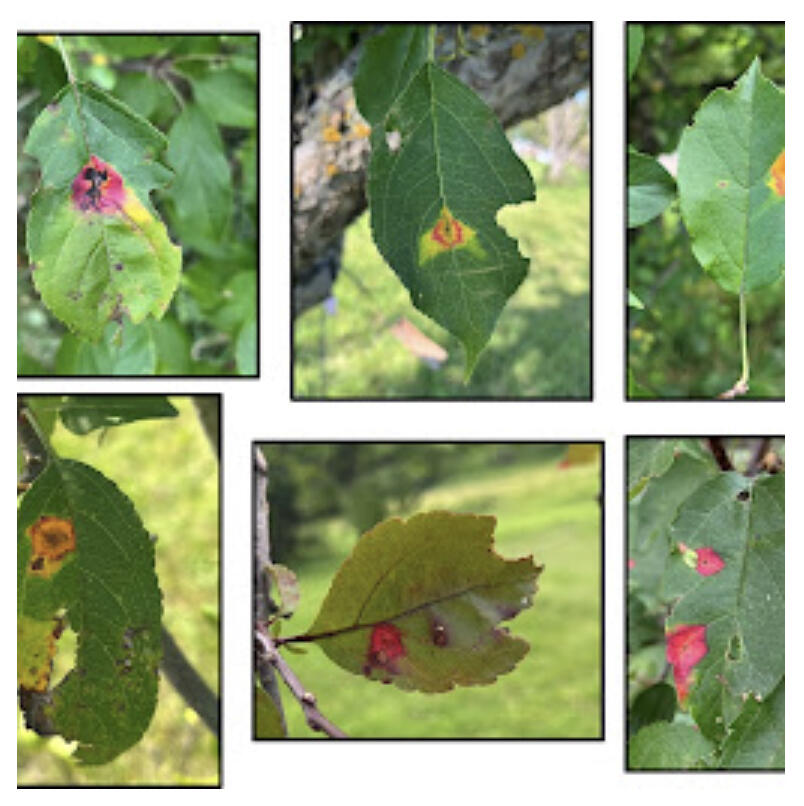
Images: Crabapple leaves with red star rust from left to right: Top: ‘Cashmere,’ ‘Dolgo,’ Firebird®; Bottom: Marilee®, ‘Prairifire,’ and ‘Purple Prince.’ The color of red star rust spots differs by cultivar. Cultivars with white flowers often have yellow spots. Cultivars with dark pink or red flowers usually have red spots.
Many growers are familiar with cedar-apple rust (Gymnosporangium juniperi-virginianae), which can impact apple leaves and fruit when infection pressure is high. There are a number of fungal pathogens in the order Pucciniales, more commonly known as rust fungi. They share a common aspect of their life cycle in that they have multiple spore stages that require two hosts in order to survive. In the case of cedar-apple rust, apples and other plants in the Rosaceae family serve as one host, while cedars and other plants in the Cupressaceae family serve as the alternate host.
But apple susceptibility isn’t limited to cedar-apple rust. One rust fungus that is less familiar to growers is red star rust, caused by the fungal pathogen Gymnosporangium yamadae. The red star rust looks different from cedar-apple rust and was more recently detected in Minnesota.
This week’s UMN Fruit and Veg Newsletter contains a new article covering information about red star rust identification on apples and junipers along with a few management tips.
Article: Red star rust: Scout For a New Apple Disease
More on cedar-apple rust

Image: A Taylor eastern redcedar (Gymnosporum juniperi-virginianae) showing cedar-apple rust telial horns, one of multiple spore-producing stages. Photo taken at the University of Wisconsin Arboretum within Madison, Wisconsin (Zone 5b).
Because this week is discussing red star rust, it might be helpful to have some supplemental information on cedar-apple rust, which is more common in Minnesota. Just like the red star rust, cedar-apple has gelatinous spore projections that are known as telial horns on cedar and other plants in the Cupressaceae family. Because these spores can travel several miles, eradication of cedars and other telial spore hosts is not usually a successful strategy for management.

Images: Cedar-apple rust looks different on the tops and bottom sides of leaves, where different spores exist on either side.
The Midwest Fruit Pest Management Guide makes note that cedar-apple rust spores are more likely to infect newly emerged leaves, which means earlier spray coverage is usually most effective for management. Spray applications are recommended beginning at green tip and continue through first cover (10 days after petal fall) at minimum. Some conventional products provide control of multiple fungal diseases.

Image: The cedar apple life cycle shares multiple hosts to complete its cycle, including cedar and apple trees. Image sourced from Cornell Cooperative Extension.
Some apple varieties additionally have a range of cedar-apple rust resistance. This includes varieties like Fireside, Freedom, Gala Supreme, McIntosh, and Liberty. Visit the University of Minnesota Extension webpage, “Cedar-apple rust and related rust diseases” to learn more about cedar-apple rust management and view lists of resistant varieties.
Day-neutral strawberries
Harvest season ramping up in southern Minnesota

Images: A container of day-neutral strawberries (left photo); and a day-neutral strawberry plant flowering and setting fruit in a caterpillar tunnel (right photo), which is an example of a modified growing environment that can help produce quality fruit and lengthen the production season.
Day-neutral strawberries produce fruit throughout the growing season and tend to peak in production in August and September in Minnesota.
Two farms that largely produce day-neutral strawberries, Little Hill Berry Farm and Twin Cities Berry Company (TCBC), grow their berries in smaller-sized high tunnels, also known as caterpillar tunnels. The tunnels help reduce environmental risks like excessive rainfall and hail.
Andy Petran, founder of TCBC, additionally focuses on high density production and grows strawberries in soilless medium using fertigation (i.e., tabletop production). To learn more about tabletop day-neutral strawberry production, refer to the following resources:
-
Growing table-top day-neutral strawberries in Minnesota (video)
-
Growing Day-Neutral Strawberries in High Tunnel Table-Top Systems (publication)
Management: Runner removal

Image: Strawberry stolons (runners) are cut and removed to encourage day-neutral strawberry plants to put their energy into fruit production. Photo taken by UMN graduate student Christina Perez, Rogers lab.
Strawberries are an herbaceous perennial. They die back to the ground as they go dormant in the fall and emerge again in the spring, never becoming woody (similar to rhubarb). Strawberries are sometimes referred to as “vines” because of their production of runners (i.e., stolons), which produce new daughter plants, but strawberries are not actually vines.
In June-bearing strawberry production, runners are allowed to root within the planting aisle to establish what is referred to as matted row production. In contrast, day-neutral strawberries are planted as individual plants within a row and runners are removed regularly to encourage the plants to put their energy into fruiting, leading to higher yields for the season.
Runner removal is time consuming, and an added labor cost but an important step for production and shouldn’t be ignored.
To learn more about day-neutral strawberry production, check out our UMN web pages:
Day-neutral strawberries (UMN webpage)
Day-neutral strawberry planting: Key points (UMN Fruit and Veg News article)
Symptom ID: Misshapen fruit (catface)

Image: Strawberries showing the symptom ‘catface' where strawberry achenes are damaged during development. Photo by Natalie Hoidal.
A common symptom seen in day-neutral strawberries is catfacing, which is a type of deformed fruit. There are a number of different causes for this symptom, but if you’re seeing it frequently on your strawberries, it’s helpful to scout for tarnished plant bugs (TPB, Lygus lineolaris).
Tarnished plant bugs are best controlled when populations are lower, so detecting populations sooner can improve management and fruit quality. Conventional controls and schedules are available in the strawberry guide for the Midwest Fruit Pest Management Guide. The Rogers lab at the University of Minnesota additionally published recommendations for organic management, where a rotation of Pyganic and DeBug Tres was most effective. For more information on TPB management and how to protect pollinators during management, check out the article in the next section below.
Catfacing and fruit deformation is not always caused by TPB. Poor pollination can also be a contributing factor, due to a lack of pollinators, rain during bloom, or high temperatures that reduce pollen viability.
Article: Tarnished plant bug in strawberries: Pollinator-friendly management considerations
For those who have scouted for and found tarnished plant bug (TPB) within a day-neutral strawberry patch, you might be wondering how to effectively manage them while minimizing harm to pollinators.
This is always an important consideration for fruit crops, but becomes even more pressing for day-neutral strawberries since they continuously bloom. Whether you’re managing your plants conventionally, or using organic methods, this article has some tips for you.
Article: Tarnished plant bug in strawberries: Pollinator-friendly management considerations
Thank you to our farm and ag professional partners for contributions to the UMN Fruit Update series. Non-credited photos in this article were either taken by Madeline Wimmer or within the UMN Extension system.
