

January garden checklist
UNIVERSITY OF MINNESOTA EXTENSION - www.extension.umn.edu
Mystery of the month

The snow melts, and you notice something is off with your lawn. What could be causing the turf near your sidewalks or other impermeable surfaces to die?
The solution is at the bottom of this article.
Pests and diseases
Protecting trees and shrubs in winter is critical for plant health.
Check the cages and wraps you put around your plants:
- Do you need to add another layer to get the fencing at least 2’ above the snowline?
- Do you need to adjust some cages so they are flush against the ground?
- Use landscape staples to keep the bottom in contact with the ground.
- Do any plant wraps need to be adjusted to better cover the plants?
Trees and shrubs
Take an inventory of your yard in winter and note where you could add plants or structures to provide winter interest in your landscape. This is also a great time of year to appreciate the showy bark of many deciduous trees and shrubs.
The Plant Elements of Design search tool is a great way to look up perennial plants that have winter interest.
Flowers and other garden plants
Make plans to order the seeds you want to start indoors this winter and spring. Before you order, inventory the seeds you already have—what seeds, the age of the seeds, and the quantity of seeds in each packet—including your seed starting supplies.
You can test seed germination using the ragdoll method if you think your seeds are too old to grow.
Houseplants
Adjust the humidity around moisture-loving houseplants by adding a humidifier to the room.
Dry air causes soil to dry out quickly from evaporation, and the plants take up more water to compensate for water lost through their leaves. So, monitor your houseplants regularly and water as needed.
Lawn
As we move into the middle of winter, it is a great opportunity to review deicing practices. Deicing salts can be effective for melting ice that has accumulated on walking or driving surfaces. However, lawns planted next to these surfaces can be sensitive to these salts if they accumulate in concentrations over winter.
If reducing the amount of deicing salts is not possible, consider planting more salt-tolerant turfgrass species. The fine fescues and tall fescue are the most salt-tolerant turfgrass species.
Other tasks
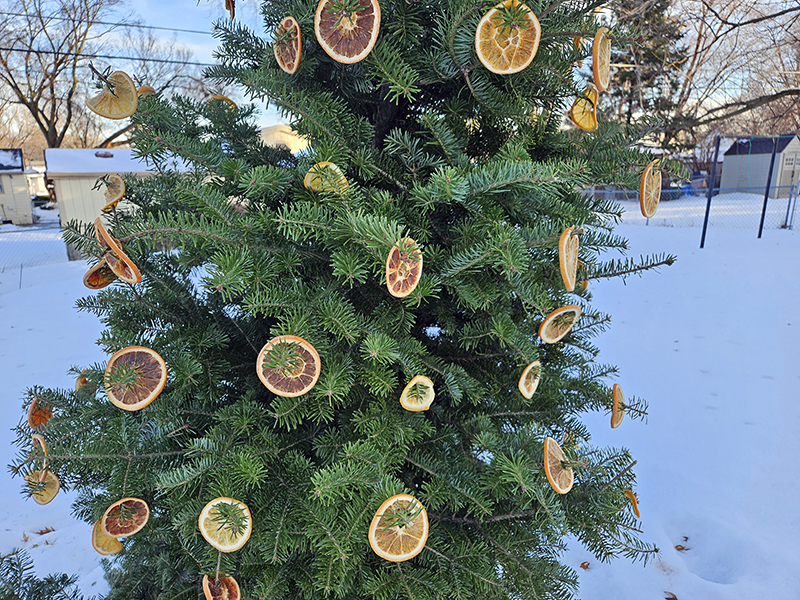
Properly dispose of holiday trees by removing all non-compostable materials like lights, tinsel, glitter, ornaments, etc.
Some ways to dispose of holiday trees include:
- Use curbside tree pick-up, if available.
- Drop off your tree at a local composting facility.
- Keep the tree in your garden to add habitat or use it as mulch, a trellis, or an interesting statement until spring.
Solution to the mystery of the month

The mystery photo shows damage from deicing salts.
Excessive salt build-up from runoff and deicing salts piling on top of the turf can kill the grass.
After the spring warm-up, weeds can outcompete the stressed turf and take over the bare areas.
Read about the effect of deicing salts on landscapes.
