
How to assess and care for damaged trees
UNIVERSITY OF MINNESOTA EXTENSION - www.extension.umn.edu
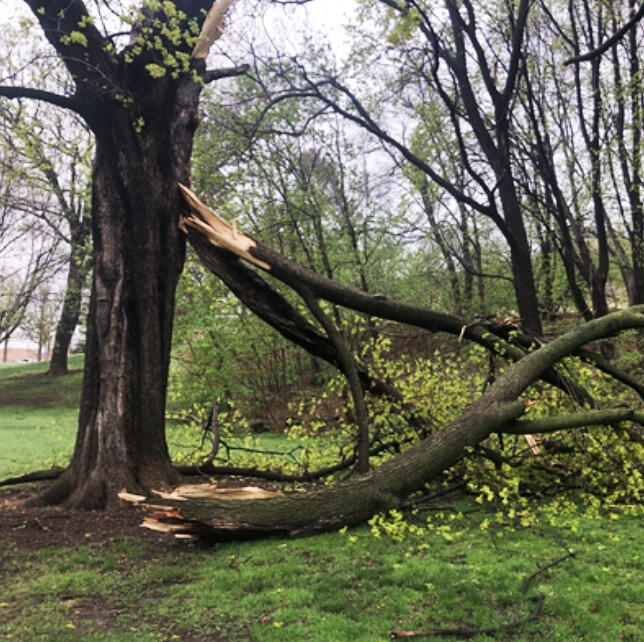
When the sky clears after a severe storm, many Minnesotans step outside to find twisted trunks, torn branches, and trees split clean in half. The recent stretch of high winds, torrential rains, and hail has been especially rough, strong enough to peel limbs and topple mature trees.
Before grabbing a saw, it’s worth knowing what storm-damaged trees can recover from, and what they cannot.
Safety first
Before anything else, look for hazards.
- Hanging limbs can fall without warning.
- Leaning trunks with soil heaving on one side often signal root failure.
- Downed power lines require an immediate call to the utility company.
If the area isn’t safe, rope it off and wait for a certified arborist.
Can this tree be saved?
Broken branches
If less than 25% of the canopy is damaged, most healthy trees bounce back.
- Make clean cuts just outside the branch collar.
- Avoid flush cuts.
- Skip wound paint; trees seal naturally.
Split or torn branch unions (the classic Y-split)
Narrow V-shaped crotches are weak points.
- Shallow, one-sided splits may be repairable with cabling or bolting.
- Splits that run halfway down the trunk, or where halves are peeling apart, mean the tree has lost structural integrity. Removal is usually your safest option.
When half the tree is gone
A sheared-off canopy leaves the tree unbalanced.
- Young trees may recover with careful pruning.
- Mature trees rarely regain stability.
- Sunscald and decay often follow major trunk exposure.
This is a good time to get a professional assessment.
Uprooted or partially uprooted trees
If 30–40% of the root plate has lifted, the tree cannot re-root. Even if it’s still standing, it’s unsafe.
What not to do
- Don’t top the tree; topping creates weak, fast-growing sprouts.
- Don’t pull a leaning tree upright with a vehicle.
- Don’t climb ladders with chainsaws; this is how most injuries occur.
Helping trees recover
After cleanup:
- Water deeply during dry spells.
- Mulch 2 to 3 inches deep, keeping mulch off the trunk.
- Avoid fertilizing right after damage.
- Watch for pests and decay for several years.
Planting for the next storm
Good care reduces future damage.
- Structural pruning in the first decade builds strong branch unions.
- Remove co-dominant stems early.
- Plant trees in groups to buffer wind.
- Avoid over-watering and over-mulching.
Wind-firm species for Minnesota
- Bur Oak
- Norway Spruce
- Hackberry
- River Birch
Storms will keep coming, but healthier, better-prepared trees mean fewer surprises when the next one rolls through. Take a walk around your yard, look closely at your trees, and choose one action—schedule a pruning, plant a wind-firm species, or book an arborist evaluation—to strengthen your landscape for the seasons ahead.
Read more about mitigating storm damage to landscape trees.
Find lists of climate-ready trees for your location.
