
Vegetable Update - June 18, 2026
UNIVERSITY OF MINNESOTA EXTENSION - www.extension.umn.edu
While things are cooler for now, the hot weather earlier this month means we are at a higher degree day total than we typically are for Mid-June. Keep up with your scouting, insects may show up earlier than we anticipate. Read on for things to keep your eyes peeled for.
Beneficial insects are out
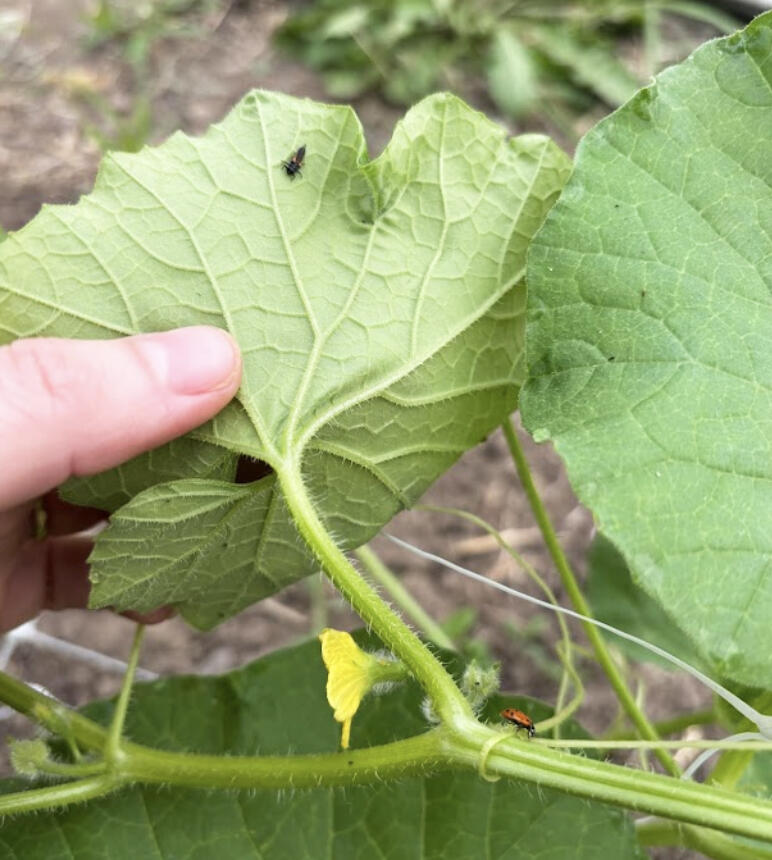
While below we will have pest updates, there are also good bugs out as well. Where you have pests, these insects are often close at their heels. Noting these when scouting might influence if you decide a pest is worth treating, or make you decide to use a softer chemistry that will preserve these insects to help you out all season long.
 |
| An immature (top) and adult (bottom) ladybeetle on patrol for aphids. Photo: Marissa Schuh, UMN Extension. |
 |
| A lacewing larvae on a high tunnel melon. Photo: Marissa Schuh, UMN Extension. |
Additional pruning content: keeping pruners clean to prevent disease spread
We wrote a bit about pruning last week. At our field day this week, Michelle Grabowski from MDA shared some additional insight on best practices for preventing disease spread while you’re pruning. There are a variety of sanitizing options available, but it is important to know what is going to preserve your tool and your patience. Common sanitizers include bleach (1 part bleach, 9 parts water, use within 24 hours) and rubbing alcohol (~70% EtOH). Both can be allowed under organic production, but check with your certifier. Common ways people sanitize include thorough spray downs, making sure the spray touches the blades but also the joints of the metal pruners, or dunking pruners into a sanitizing solution. Some growers have a sanitizing station at the end of their high tunnels, others have tools belts or aprons with multiple pruners and a sanitizer. Find something that makes the practice easy enough where you will actually do it.
How often to sanitize pruners? In a way that will make you do it! Pathogens that can be spread with pruners can also transfer to plants that are rubbing together, so it isn’t necessary to clean after every plant (unless mid-pruning you realize the plant you’re working on looks a little off). Instead, sanitize pruners where there are natural breaks where plants aren’t touching, in between varieties, or when you reach the end of the row. At a minimum, start each day with cleaned/sanitized pruners.
Weed management corner
The regular rains have been bringing out flushes of weeds. At your wits end? We still have 3 weed management focused field days (including next week in Farmington) that will give you hands-on experience operating and fine tuning different wheel hoes, walk behind tractors, and full size tractors. More info and registration in our previous blog post about the events.
 |
| Have a weedy field edge with Canada thistle? Make sure to mow now, when the plants are forming flower buds. This is a time when plants are using lots of energy, so an extra effective time to mow them. Photo: Marissa Schuh, UMN Extension. |
Slugs!
 |
| Slug damage in radish. Grower submitted photo. |
Despite being in drought across a lot of the state, pockets of Minnesota have been cool and wet this week, and we’ve seen some slug damage. Using a bait product like Sluggo can be effective for managing slugs.
Crop updates
High tunnel cucumbers: Stand in your high tunnel long enough and you will probably see your plants growing right before your eyes. Pests are out – with thrips and aphids present in a high tunnel we visited this week. See above photos of beneficial insects, they were out too. We’ve been thinking of high tunnel cucumber trellising options as either a pruned, single leader trellis system, or a net. Our field day host this week, Ben, informed us that last year he did trellis his cucumbers on a single leader, but didn’t do any pruning. The plants (Carmen variety) seemed to perform well, and not pruning saved a lot of time and scratched up hands.
High tunnel tomatoes: Tomatoes are starting to set fruit, which is a time where plant stress as well as water and nutrient use ticks up. In general, tomatoes in high tunnels benefit from a little bit of spoon-feeding. Think of it like a marathon vs. a 5k. Your field vegetables might be running a 5K, and a hearty bowl of pasta the night before and a hearty breakfast (aka applying fertility to the soil at planting) might provide sufficient nutrition. The high tunnel tomatoes are running a marathon, and while the hearty meal (fertility applied to the soil at planting) is still super important, some sugary drinks, goo, or whatever else marathon runners eat is also needed to get you the final few miles. In tomatoes, this generally looks like foliar feeding or fertigation. While we still lack good research-based recommendations, in discussions with educators in other states we are landing around 5 lbs of nitrogen (per acre) per week, and equal or more potassium. Let’s say your high tunnel production area is about 28’x 90’, that’s 2,520 sq ft, so you’re looking at about 0.28 lbs of nitrogen to your high tunnel per week (scaling down 5 lbs per acre to the size of your tunnel). If you’re using blood meal, which is 12% nitrogen, that’s about 2.5 lbs of bloodmeal per week. Super fine potassium sulfate can also be dissolved in irrigation water for spoon-feeding potassium.
A common question right now is about leaf edge yellowing. In a high tunnel, this is likely potassium deficiency, but there is also a risk of bacterial canker (especially if you have a history of this disease in your high tunnel).
- Potassium deficiencies can start to show up around this time, as tomatoes begin to use a ton of potassium when they start fruiting. This usually looks like yellow leaf margins in the ”teenage” leaves: not the newest leaves, but not the oldest either. As it advances, the leaf tips become brown. While we'd love to add a textbook photo of potassium deficiency, nutrient deficiency symptoms are often a bit complicated, and often we see multiple deficiencies at once.
- Bacterial canker is a disease that can be seedborne, and can come in on transplants. It can also hang around in a tunnel on surfaces and plant residues. Symptoms you might see this time of year are “firing” - leaf edge yellowing followed by necrosis. Check out the vascular tissue when you are pruning, looking for discoloration when making cuts. Make a fresh horizontal cut, as well as a series of cuts along the stem.
 |
| Leaf edge necrosis due to bacterial canker. Photo: Dan Egel, Purdue University. |
 |
| Discolored vascular tissue due to bacterial canker. Photo: Dan Egel, Purdue University. |
Crop updates
Peas: Harvest is beginning on some farms.
Strawberries started off strong with high yields last week, but are slowing down with the cool weather. The strawberries we’ve seen so far have been healthy, with minimal catfacing.
Brassicas: Early planted Brassicas, including leafy greens, are starting to bolt. However, as farmers have shifted to sprouting broccolis and even sprouting cauliflowers, this is becoming less of an issue. Customers seem happy to get bunches of greens with some sweet yellow flowers in them, and these flowers support beneficial insects on the farm.
Tomatillos: If you have holes in your plants, check for three-lined potato beetles. You may see adults, who are yellow with black stripes and orange head, or the larvae, who are slug-like and cover themselves in their own frass. Squishing and shaking bugs into buckets of soapy water can often take care of these guys in smaller plantings. Check the undersides of leaves for clusters of oval-shaped orange eggs. Squishing eggs can also be effective on a small scale.
Lettuce: we often see white mold emerge in lettuce crops in the late spring. So far, the farmers we’ve checked in with have seen less white mold pressure than usual. If you are seeing it, please let us know! We’re doing some scoping for a potential white mold research project, and trying to understand how widespread and damaging it is.
Vine crops: University of Wisconsin degree days tools suggest that adult squash vine borer might start flying 1-2 weeks earlier than we may expect this year. The southern tier of Minnesota counties has arrived at the degree day threshold (1000 base 50 degree days) where we typically see this pest. Keep an eye out for adults when working near your vining crops, and be ready to implement your management of choice. Crops most at risk are pumpkins, winter squash, and summer squash (which tend to have the big, meaty crowns the caterpillars of this pest love to eat).
Whether using organic or conventional pesticides, timing of application is key, and the windows for our sprays to contact this pest are small blocks of time within the 2-4 weeks where moths are flying and laying eggs. The caterpillars of this pest spend a lot of their lives feeding in the crown – once they are in there, we can’t reach them with any insecticide. This means we need to have products consistently present on the crown of plants during the entire monthlong flight period.
For conventional growers, products have a longer window of activity, making this more feasible. See options in the Midwest Vegetable Production Guide. Make two or three applications every 5-7 days. The NE Vegetable Guide recommends azadiractin, while UW writes in their newsletter that Entrust or Dipel may work – none of these have a lot of residual activity, so more applications than is recommended for conventional products may be needed. For some growers, planting extra (which we still have time to do!) may be more feasible.
More management information on the UMN Extension webpage “Squash vine borer.”
